Earth Notes: On Variations in GB Grid Electricity CO2 Intensity: Samples
Updated 2026-03-25 13:22 GMT.By Damon Hart-Davis
 .
.

Introduction
(Note also that the Northern Ireland grid is closely coupled to the Republic's, and so the numbers presented here are in fact for GB ie England/Scotland/Wales.)
Also, with significant penetration of intermittent renewables such as wind (~5% of peak winter demand – with a target of maybe 50% of peak) then the hour-by-hour intensity is even more volatile and hard to know.
There are several different 'average' values quoted and used too, eg: the UK government's 'aspirational' marginal cost of about 0.43kgCO2/kWh, the DEFRA 3-year rolling average figure (0.52kgCO2/kWh as of –), 0.422kgCO2/kWh for grid-supplied electricity and 0.568kgCO2/kWh grid-displaced electricity to compute emissions for UK building regulations (, part L).
Incidentally, a working assumption of mine has been that grid CO2 intensity will peak when demand does because everything will be working flat out, including all the 'dirtiest' (most CO2-intense) generators. Clare Hanmer of the Carbon Trust did some work that suggests this is not necessarily so, and also that the diurnal/daily swing in intensity is larger in summer than in winter, given some educated guesses, etc. Part of my reason for this note is to test her interesting assertions! I'm borrowing some of her numbers and assumptions shamelessly.
(: see this critique to which I respond that load shifting is probably better considered in terms of load curve peak shaving or shaping to renewables availability, and in terms of leaving scarce storage for other grid users. So, where you have a load timing choice (1) avoid peak grid demand and (2) run the load when grid-attached storage is filling up, (3) maximise utility of grid flows in locations with microgeneration, but only after (4) minimising load in the first place.)
Data Source: ELEXON
For the GB system, (ie the UK excluding Northern Ireland)
ELEXON provides real-time and historical data on a number of grid parameters through the bmreports.com site, including generation by fuel type of plant connected to the high voltage transmission system. This does not by any means represent all generation, and may in particular under-represent wind and other distributed generation that connects at lower voltages and even within the distribution networks.
Total operational metered wind is shown with capacity 1288MW at , whereas the BWEA lists (for the whole UK) 3301MW capacity. (Site http://www.renewableuk.com/en/renewable-energy/wind-energy/uk-wind-energy-database/ as of .)
As at the BWEA UKWED database shows 3625MW of operational UK wind capacity and the BWEA's Jan Matthiesen kindly told me that 215MW of that is in Northern Ireland, ie not in the GB grid. At the same time the Elexon GB metered wind capacity is 1426MW, ie ~60% of the UK's operational capacity is embedded and not visible in Elexon's stats, so wind already is a significantly 'distributed' source.
ELEXON has very helpfully licensed me their data to conduct this study and related work.
: Late March 2009: Sample 1
For the first 24-hour period that I examined from early March 2009, and ignoring the effects of pumped storage and interconnectors entirely, I saw ~20% variation in intensity in the 'high-voltage' connected generation, and an average for a consumer (including 9% loss in transmission/distribution) of well above the government's 'aspirational' marginal-generation figure and slightly above the 3-year DEFRA rolling-average. The intensity was fairly flat (and high) until about 8pm (after peak demand), and dropped to a low around midnight and rose again to 'high' around 8am, so showing a fairly strong first-order correlation of intensity with demand. There may have been more coal and less nuclear in the mix than typical.
: Night: Sample 2
This 24-hour period during a bank-holiday weekend shows a 24% variance in kgCO2/kWh; intensity is relatively low because there is relatively little coal in the mix (<20%).
Effective grid carbon intensity for a domestic user is currently 327gCO2/kWh including transmission and distribution losses of 9%.
Latest available grid generation carbon intensity (ignoring transmission/distribution losses) is approximately 300gCO2/kWh at Mon Apr 13 00:55:00 BST 2009 over 26467MW of generation, with a rolling average over 24h of 350gCO2/kWh.
Minimum grid generation carbon intensity (ignoring transmission/distribution losses) was approximately 299gCO2/kWh at Mon Apr 13 00:45:00 BST 2009.
Maximum grid generation carbon intensity (ignoring transmission/distribution losses) was approximately 389gCO2/kWh at Sun Apr 12 22:05:00 BST 2009.
Average/mean grid generation carbon intensity (ignoring transmission/distribution losses) was approximately 350gCO2/kWh over the sample data set, with an effective end-user intensity including transmission and distribution losses of 382gCO2/kWh.
| Recent mean GMT hourly generation intensity gCO2/kWh (average=350); * = now | |||||||||||||||||||||||
|---|---|---|---|---|---|---|---|---|---|---|---|---|---|---|---|---|---|---|---|---|---|---|---|
| 00 | 01 | 02 | 03 | 04 | 05 | 06 | 07 | 08 | 09 | 10 | 11 | 12 | 13 | 14 | 15 | 16 | 17 | 18 | 19 | 20 | 21 | 22 | 23* |
|
|
|
|
|
|
|
|
|
|
|
|
|
|
|
|
|
|
|
|
|
|
|
|
Overall generation intensity (kgCO2/kWh) computed using the following fuel intensities (other fuels/sources are ignored): CCGT=0.36 COAL=0.91 INTFR=0.09 NPSHYD=0.0 NUCLEAR=0.0 OCGT=0.48 OIL=0.61 OTHER=0.61 WIND=0.0.
: Evening: Sample 3
For some reason there seems to have been an enormous (~40%) variation min to max; hour-by-hour variation is ~30%. (Overnight intensity then dropped to 289gCO2/kWh making the mean 381gCO2/kWh and variability a whopping 44%!)
Effective grid carbon intensity for a domestic user is currently 425gCO2/kWh including transmission and distribution losses of 9%.
Latest available grid generation carbon intensity (ignoring transmission/distribution losses) is approximately 390gCO2/kWh at Wed Apr 15 21:40:00 BST 2009 over 37690MW of generation, with a rolling average over 24h of 393gCO2/kWh.
Minimum grid generation carbon intensity (ignoring transmission/distribution losses) was approximately 310gCO2/kWh at Wed Apr 15 00:15:00 BST 2009.
Maximum grid generation carbon intensity (ignoring transmission/distribution losses) was approximately 508gCO2/kWh at Wed Apr 15 20:45:00 BST 2009.
Average/mean grid generation carbon intensity (ignoring transmission/distribution losses) was approximately 393gCO2/kWh over the sample data set, with an effective end-user intensity including transmission and distribution losses of 428gCO2/kWh.
| Recent mean GMT hourly generation intensity gCO2/kWh (average=393); * = now | |||||||||||||||||||||||
|---|---|---|---|---|---|---|---|---|---|---|---|---|---|---|---|---|---|---|---|---|---|---|---|
| 21 | 22 | 23 | 00 | 01 | 02 | 03 | 04 | 05 | 06 | 07 | 08 | 09 | 10 | 11 | 12 | 13 | 14 | 15 | 16 | 17 | 18 | 19 | 20* |
|
|
|
|
|
|
|
|
|
|
|
|
|
|
|
|
|
|
|
|
|
|
|
|
Current/latest fuel mix: CCGT@17709MW COAL@8889MW INTFR@1572MW INTIRL@0MW NPSHYD@269MW NUCLEAR@8581MW OCGT@0MW OIL@0MW OTHER@0MW PS@199MW WIND@471MW.
Overall generation intensity (kgCO2/kWh) computed using the following fuel intensities (other fuels/sources are ignored): CCGT=0.36 COAL=0.91 INTFR=0.09 NPSHYD=0.0 NUCLEAR=0.0 OCGT=0.48 OIL=0.61 OTHER=0.61 WIND=0.0.
: Evening: Sample 4
As of this sample there had been a potential time-shifting saving in the last 24 hours of 35%.
Effective grid carbon intensity for a domestic user is currently 460gCO2/kWh including transmission and distribution losses of 9%.
Latest available grid generation carbon intensity (ignoring transmission/distribution losses) is approximately 422gCO2/kWh at Mon Jun 29 20:55:00 BST 2009 over 35535MW of generation, with a rolling average over 24h of 422gCO2/kWh.
Minimum grid generation carbon intensity (ignoring transmission/distribution losses) was approximately 324gCO2/kWh at Mon Jun 29 03:10:00 BST 2009.
Maximum grid generation carbon intensity (ignoring transmission/distribution losses) was approximately 494gCO2/kWh at Mon Jun 29 14:10:00 BST 2009.
Average/mean grid generation carbon intensity (ignoring transmission/distribution losses) was approximately 422gCO2/kWh over the sample data set, with an effective end-user intensity including transmission and distribution losses of 460gCO2/kWh.
| Recent mean GMT hourly generation intensity gCO2/kWh (average=422); *now (=422) | |||||||||||||||||||||||
|---|---|---|---|---|---|---|---|---|---|---|---|---|---|---|---|---|---|---|---|---|---|---|---|
| 20 | 21 | 22 | 23 | 00 | 01 | 02 | 03 | 04 | 05 | 06 | 07 | 08 | 09 | 10 | 11 | 12 | 13 | 14 | 15 | 16 | 17 | 18 | 19* |
|
|
|
|
|
|
|
|
|
|
|
|
|
|
|
|
|
|
|
|
|
|
|
|
| Mean GMT hourly generation GW (all, zero-carbon) | |||||||||||||||||||||||
|
|
|
|
|
|
|
|
|
|
|
|
|
|
|
|
|
|
|
|
|
|
|
|
Hours that are basically green, but in which there is draw-down from grid-connected storage with its attendant energy losses and also suggesting that little or no excess non-dispatchable generation is available, ie that are marginally green, are shaded olive.
Current/latest fuel mix at Mon Jun 29 20:55:00 BST 2009: CCGT@16377MW COAL@9820MW INTFR@248MW INTIRL@0MW NPSHYD@135MW NUCLEAR@8539MW OCGT@0MW OIL@0MW OTHER@0MW PS@294MW WIND@122MW.
Current draw-down from storage is 294MW.
Overall generation intensity (kgCO2/kWh) computed using the following fuel intensities (other fuels/sources are ignored): CCGT=0.36 COAL=0.91 INTFR=0.09 NPSHYD=0.0 NUCLEAR=0.0 OCGT=0.48 OIL=0.61 OTHER=0.61 WIND=0.0.
Key to fuel types/names:
- CCGT
- Combined-Cycle Gas Turbine
- INTFR
- French Interconnector
- INTIRL
- Irish Interconnector
- NPSHYD
- Non-Pumped-Storage Hydro
- OCGT
- Open-Cycle Gas Turbine
- PS
- Pumped Storage Hydro
: Evening: Sample 5
The intensity curve is unusually flat with coal apparently doing load-following (only ~7% min to max, and within a couple of days was down to ~4%), probably because of the gas shortage in the cold weather (with a gas demand of 441m^3/4.9TWh or ~200GW average over the day, causing National Grid to issue a Gas Balancing Alert (GBA) at 13:10 for Gas Day 04/01/2010, and demand went higher still later in the week) and a lack of (nuclear, ie low-carbon) electricity imports from France. There is also a big change in usage given the first two working days back since Christmas.
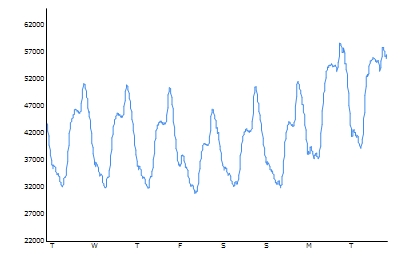
Effective grid carbon intensity for a domestic user is currently 583gCO2/kWh including transmission and distribution losses of 9%.
Latest available grid generation carbon intensity (ignoring transmission/distribution losses) is approximately 535gCO2/kWh at Tue Jan 05 20:10:00 UTC 2010 over 54357MW of generation, with a rolling average over 24h of 533gCO2/kWh.
Minimum grid generation carbon intensity (ignoring transmission/distribution losses) was approximately 513gCO2/kWh at Tue Jan 05 05:00:00 UTC 2010.
Maximum grid generation carbon intensity (ignoring transmission/distribution losses) was approximately 549gCO2/kWh at Mon Jan 04 22:05:00 UTC 2010.
Average/mean grid generation carbon intensity (ignoring transmission/distribution losses) was approximately 533gCO2/kWh over the sample data set, with an effective end-user intensity including transmission and distribution losses of 581gCO2/kWh.
| Recent mean GMT hourly generation intensity gCO2/kWh (average=533); *now (=535) | |||||||||||||||||||||||
|---|---|---|---|---|---|---|---|---|---|---|---|---|---|---|---|---|---|---|---|---|---|---|---|
| 21 | 22 | 23 | 00 | 01 | 02 | 03 | 04 | 05 | 06 | 07 | 08 | 09 | 10 | 11 | 12 | 13 | 14 | 15 | 16 | 17 | 18 | 19 | 20* |
|
|
|
|
|
|
|
|
|
|
|
|
|
|
|
|
|
|
|
|
|
|
|
|
| Mean GMT hourly generation GW (all, zero-carbon) | |||||||||||||||||||||||
|
|
|
|
|
|
|
|
|
|
|
|
|
|
|
|
|
|
|
|
|
|
|
|
Current/latest fuel mix at Tue Jan 05 20:10:00 UTC 2010: CCGT@21678MW COAL@22760MW INTFR@0MW INTIRL@0MW NPSHYD@219MW NUCLEAR@7761MW OCGT@0MW OIL@0MW OTHER@0MW PS@1076MW WIND@863MW.
Current draw-down from storage is 1076MW.
Generation by fuel category:
- fossil
- 44438MW [CCGT, COAL, INTIRL, OCGT, OIL, OTHER]
- nuclear
- 7761MW [INTFR, NUCLEAR]
- renewable
- 1082MW [NPSHYD, WIND]
- storage
- 1076MW [PS]
- zero-carbon
- 8843MW [NPSHYD, NUCLEAR, WIND]
Overall generation intensity (kgCO2/kWh) computed using the following fuel intensities (other fuels/sources are ignored): CCGT=0.36 COAL=0.91 INTFR=0.09 INTIRL=0.7 NPSHYD=0.0 NUCLEAR=0.0 OCGT=0.48 OIL=0.61 OTHER=0.61 WIND=0.0.
Key to fuel codes:
- CCGT
- Combined-Cycle Gas Turbine
- INTFR
- French Interconnector
- INTIRL
- Irish Interconnector
- NPSHYD
- Non-Pumped-Storage Hydro
- OCGT
- Open-Cycle Gas Turbine
- PS
- Pumped Storage Hydro
: Evening: Sample 6
This was an unseasonably-cold day with the unusual circumstance of very flat (~6%) grid intensity (possibly due to exports to France) with peak demand still being in the lowest intensity quartile.
Effective grid carbon intensity for a domestic user is currently 572gCO2/kWh including transmission and distribution losses of 9%.
Latest available grid generation carbon intensity (ignoring transmission/distribution losses) is approximately 525gCO2/kWh at Fri Nov 26 17:55:00 UTC 2010 over 54644MW of generation, with a rolling average over 24h of 533gCO2/kWh.
Minimum grid generation carbon intensity (ignoring transmission/distribution losses) was approximately 520gCO2/kWh at Fri Nov 26 04:20:00 UTC 2010.
Maximum grid generation carbon intensity (ignoring transmission/distribution losses) was approximately 548gCO2/kWh at Thu Nov 25 20:35:00 UTC 2010.
Average/mean grid generation carbon intensity (ignoring transmission/distribution losses) was approximately 533gCO2/kWh over the sample data set, with an effective end-user intensity including transmission and distribution losses of 581gCO2/kWh.
| Recent mean GMT hourly generation intensity gCO2/kWh (average=533); *now (=525) | |||||||||||||||||||||||
|---|---|---|---|---|---|---|---|---|---|---|---|---|---|---|---|---|---|---|---|---|---|---|---|
| 18 | 19 | 20 | 21 | 22 | 23 | 00 | 01 | 02 | 03 | 04 | 05 | 06 | 07 | 08 | 09 | 10 | 11 | 12 | 13 | 14 | 15 | 16 | 17* |
|
|
|
|
|
|
|
|
|
|
|
|
|
|
|
|
|
|
|
|
|
|
|
|
| Mean GMT hourly generation GW (all, zero-carbon) | |||||||||||||||||||||||
|
|
|
|
|
|
|
|
|
|
|
|
|
|
|
|
|
|
|
|
|
|
|
|
Hours that are basically green, but in which there is draw-down from grid-connected storage with its attendant energy losses and also suggesting that little or no excess non-dispatchable generation is available, ie that are marginally green, are shaded olive.
Current/latest fuel mix at Fri Nov 26 17:55:00 UTC 2010: CCGT@23528MW COAL@21395MW INTFR@1261MW INTIRL@0MW NPSHYD@758MW NUCLEAR@6185MW OCGT@0MW OIL@0MW OTHER@0MW PS@1185MW WIND@332MW.
Current draw-down from storage is 1185MW.
Generation by fuel category:
- fossil
- 44923MW [CCGT, COAL, INTIRL, OCGT, OIL, OTHER]
- nuclear
- 7446MW [INTFR, NUCLEAR]
- renewable
- 1090MW [NPSHYD, WIND]
- storage
- 1185MW [PS]
- zero-carbon
- 7275MW [NPSHYD, NUCLEAR, WIND]
Overall generation intensity (kgCO2/kWh) computed using the following fuel intensities (other fuels/sources are ignored): CCGT=0.36 COAL=0.91 INTFR=0.09 INTIRL=0.7 NPSHYD=0.0 NUCLEAR=0.0 OCGT=0.48 OIL=0.61 OTHER=0.61 WIND=0.0.
Key to fuel codes:
- CCGT
- Combined-Cycle Gas Turbine
- INTFR
- French Interconnector
- INTIRL
- Irish Interconnector
- NPSHYD
- Non-Pumped-Storage Hydro
- OCGT
- Open-Cycle Gas Turbine
- PS
- Pumped Storage Hydro
: Morning: Sample 7
For the last few days, partly because of the very cold weather across Europe, the normal pattern has been broken with highest carbon intensity seen in the wee hours even though demand is low, and the lowest intensity around peak times and with pumped storage in use.
One consequence is that the 'supergreen' flag has not been active for days, which would be the normal combination of bottom-quartile intensity and no draw-down from storage. I haven't seen this behaviour before.
Note that wind generation has varied between ~100MW and well over 2GW, so that is not the main factor: high and consistent coal-fired generation has probably had a bigger effect. Note the relatively flat (~9%) intensity. We were exporting ~3GW to France and the Netherlands around the sample time, and have probably been propping up the French and German grids with our coal.
Effective grid carbon intensity for a domestic user is currently 576gCO2/kWh including transmission and distribution losses of 7%.
Latest available grid generation carbon intensity (ignoring transmission/distribution losses) is approximately 538gCO2/kWh at Wed Feb 08 08:50:00 UTC 2012 over 53298MW of generation, with a rolling average over 24h of 557gCO2/kWh.
Minimum grid generation carbon intensity (ignoring transmission/distribution losses) was approximately 531gCO2/kWh at Tue Feb 07 17:45:00 UTC 2012.
Maximum grid generation carbon intensity (ignoring transmission/distribution losses) was approximately 582gCO2/kWh at Wed Feb 08 05:25:00 UTC 2012.
Average/mean grid generation carbon intensity (ignoring transmission/distribution losses) was approximately 557gCO2/kWh over the sample data set, with an effective end-user intensity including transmission and distribution losses of 596gCO2/kWh.
| Recent mean GMT hourly generation intensity gCO2/kWh (average=557); *now (=538) | |||||||||||||||||||||||
|---|---|---|---|---|---|---|---|---|---|---|---|---|---|---|---|---|---|---|---|---|---|---|---|
| 09 | 10 | 11 | 12 | 13 | 14 | 15 | 16 | 17 | 18 | 19 | 20 | 21 | 22 | 23 | 00 | 01 | 02 | 03 | 04 | 05 | 06 | 07 | 08* |
|
|
|
|
|
|
|
|
|
|
|
|
|
|
|
|
|
|
|
|
|
|
|
|
| Mean GMT hourly generation GW (all, zero-carbon) | |||||||||||||||||||||||
|
|
|
|
|
|
|
|
|
|
|
|
|
|
|
|
|
|
|
|
|
|
|
|
Hours that are basically green, but in which there is draw-down from grid-connected storage with its attendant energy losses and also suggesting that little or no excess non-dispatchable generation is available, ie that are marginally green, are shaded olive.
Current/latest fuel mix at Wed Feb 08 08:50:00 UTC 2012: CCGT@17080MW COAL@23930MW INTFR@0MW INTIRL@0MW INTNED@0MW NPSHYD@634MW NUCLEAR@7983MW OCGT@132MW OIL@0MW OTHER@500MW PS@732MW WIND@2307MW.
Current draw-down from storage is 732MW.
Generation by fuel category (may overlap):
- fossil @ 78%
- 41642MW [CCGT, COAL, INTIRL, INTNED, OCGT, OIL, OTHER]
- import @ 0%
- 0MW [INTFR, INTIRL, INTNED]
- nuclear @ 15%
- 7983MW [INTFR, NUCLEAR]
- renewable @ 6%
- 2941MW [NPSHYD, WIND]
- storage @ 1%
- 732MW [PS]
- zero-carbon @ 20%
- 10924MW [NPSHYD, NUCLEAR, WIND]
Overall generation intensity (kgCO2/kWh) computed using the following fuel intensities (other fuels/sources are ignored): CCGT=0.36 COAL=0.91 INTFR=0.09 INTIRL=0.7 INTNED=0.55 NPSHYD=0.0 NUCLEAR=0.0 OCGT=0.48 OIL=0.61 OTHER=0.61 WIND=0.0.
Key to fuel codes:
- CCGT
- Combined-Cycle Gas Turbine
- INTFR
- French Interconnector
- INTIRL
- Irish Interconnector
- INTNED
- Netherlands Interconnector
- NPSHYD
- Non-Pumped-Storage Hydro
- OCGT
- Open-Cycle Gas Turbine
- PS
- Pumped Storage Hydro
: Morning: Sample 8
Very interesting lack of correlation between demand and intensity overnight.
Effective grid carbon intensity for a domestic user is currently 538gCO2/kWh including transmission and distribution losses of 7%.
Latest available grid generation carbon intensity (ignoring transmission/distribution losses) is approximately 503gCO2/kWh at Mon Jul 16 09:20:00 UTC 2012 over 39247MW of generation, with a rolling average over 24h of 446gCO2/kWh.
Minimum grid generation carbon intensity (ignoring transmission/distribution losses) was approximately 425gCO2/kWh at Sun Jul 15 12:45:00 UTC 2012.
Maximum grid generation carbon intensity (ignoring transmission/distribution losses) was approximately 506gCO2/kWh at Mon Jul 16 07:25:00 UTC 2012.
Average/mean grid generation carbon intensity (ignoring transmission/distribution losses) was approximately 446gCO2/kWh over the sample data set, with an effective end-user intensity including transmission and distribution losses of 477gCO2/kWh.
| Recent mean GMT hourly generation intensity gCO2/kWh (average=446); *now (=503) | |||||||||||||||||||||||
|---|---|---|---|---|---|---|---|---|---|---|---|---|---|---|---|---|---|---|---|---|---|---|---|
| 10 | 11 | 12 | 13 | 14 | 15 | 16 | 17 | 18 | 19 | 20 | 21 | 22 | 23 | 00 | 01 | 02 | 03 | 04 | 05 | 06 | 07 | 08 | 09* |
|
|
|
|
|
|
|
|
|
|
|
|
|
|
|
|
|
|
|
|
|
|
|
|
| Mean GMT hourly generation GW (all, zero-carbon) | |||||||||||||||||||||||
|
|
|
|
|
|
|
|
|
|
|
|
|
|
|
|
|
|
|
|
|
|
|
|
Hours that are basically green, but in which there is draw-down from grid-connected storage with its attendant energy losses and also suggesting that little or no excess non-dispatchable generation is available, ie that are marginally green, are shaded olive.
Current/latest fuel mix at Mon Jul 16 09:20:00 UTC 2012: CCGT@12342MW COAL@15806MW INTEW@0MW INTFR@996MW INTIRL@0MW INTNED@992MW NPSHYD@335MW NUCLEAR@7206MW OCGT@30MW OIL@0MW OTHER@146MW PS@472MW WIND@922MW.
Current draw-down from storage is 472MW.
Generation by fuel category (may overlap):
- fossil @ 72%
- 28178MW [CCGT, COAL, OCGT, OIL]
- import @ 5%
- 1988MW [INTEW, INTFR, INTIRL, INTNED]
- nuclear @ 21%
- 8202MW [INTFR, NUCLEAR]
- renewable @ 3%
- 1257MW [NPSHYD, WIND]
- storage @ 1%
- 472MW [PS]
- zero-carbon @ 22%
- 8463MW [NPSHYD, NUCLEAR, WIND]
Overall generation intensity (kgCO2/kWh) computed using the following fuel intensities (other fuels/sources are ignored): CCGT=0.36 COAL=0.91 INTEW=0.45 INTFR=0.09 INTIRL=0.45 INTNED=0.55 NPSHYD=0.0 NUCLEAR=0.0 OCGT=0.48 OIL=0.61 OTHER=0.3 WIND=0.0.
Key to fuel codes:
- CCGT
- Combined-Cycle Gas Turbine
- INTEW
- East-West (Irish) Interconnector
- INTFR
- French Interconnector
- INTIRL
- Irish (Moyle) Interconnector
- INTNED
- Netherlands Interconnector
- NPSHYD
- Non-Pumped-Storage Hydro
- OCGT
- Open-Cycle Gas Turbine
- OTHER
- Other (including biomass)
- PS
- Pumped Storage Hydro
: Wee hours: Sample 9
At this point about 50% of GB demand as seen by Elexon was coming from zero-carbon sources: 80% of that nukes and most of the rest from wind. (Note that about half of wind is not metered here, and these numbers also looked better from a zero-carbon point of view a little earlier.)
Current/latest fuel mix at Fri Aug 17 03:30:00 UTC 2012: CCGT@5516MW COAL@8267MW INTEW@0MW INTFR@0MW INTIRL@0MW INTNED@0MW NPSHYD@105MW NUCLEAR@8527MW OCGT@0MW OIL@0MW OTHER@0MW PS@0MW WIND@2182MW.
Generation by fuel category (may overlap):
- fossil @ 56%
- 13783MW [CCGT, COAL, OCGT, OIL]
- import @ 0%
- 0MW [INTEW, INTFR, INTIRL, INTNED]
- nuclear @ 35%
- 8527MW [INTFR, NUCLEAR]
- renewable @ 9%
- 2287MW [NPSHYD, WIND]
- storage @ 0%
- 0MW [PS]
- zero-carbon @ 44%
- 10814MW [NPSHYD, NUCLEAR, WIND]
: Wee hours over 50% zero-carbon generation: Sample 10
| Recent mean GMT hourly generation intensity gCO2/kWh (average=246); *now (=269) | |||||||||||||||||||||||
|---|---|---|---|---|---|---|---|---|---|---|---|---|---|---|---|---|---|---|---|---|---|---|---|
| 11 | 12 | 13 | 14 | 15 | 16 | 17 | 18 | 19 | 20 | 21 | 22 | 23 | 00 | 01 | 02 | 03 | 04 | 05 | 06 | 07 | 08 | 09 | 10* |
|
|
|
|
|
|
|
|
|
|
|
|
|
|
|
|
|
|
|
|
|
|
|
|
| Mean GMT hourly generation GW (all, zero-carbon) | |||||||||||||||||||||||
|
|
|
|
|
|
|
|
|
|
|
|
|
|
|
|
|
|
|
|
|
|
|
|
Current/latest fuel mix at Mon Aug 11 10:10:00 UTC 2014: CCGT@12958MW COAL@3655MW INTEW@0MW INTFR@1996MW INTIRL@0MW INTNED@1028MW NPSHYD@348MW NUCLEAR@7280MW OCGT@0MW OIL@0MW OTHER@749MW PS@361MW WIND@5262MW.
Current draw-down from storage is 361MW.
Generation by fuel category (may overlap):
- fossil @ 49%
- 16613MW [CCGT, COAL, OCGT, OIL]
- import @ 9%
- 3024MW [INTEW, INTFR, INTIRL, INTNED]
- nuclear @ 28%
- 9276MW [INTFR, NUCLEAR]
- renewable @ 17%
- 5610MW [NPSHYD, WIND]
- storage @ 1%
- 361MW [PS]
- zero-carbon @ 38%
- 12890MW [NPSHYD, NUCLEAR, WIND]
Overall generation intensity (kgCO2/kWh) computed using the following fuel intensities (other fuels/sources are ignored): CCGT=0.36 COAL=0.91 INTEW=0.45 INTFR=0.09 INTIRL=0.45 INTNED=0.55 NPSHYD=0.0 NUCLEAR=0.0 OCGT=0.48 OIL=0.61 OTHER=0.3 WIND=0.0.
Rolling correlation of fuel use against grid intensity (-ve implies that this fuel reduces grid intensity for non-callable sources): CCGT=0.9422 COAL=0.9840 INTEW=-0.5662 INTFR=0.8420 INTNED=0.8021 NPSHYD=0.6395 NUCLEAR=0.2828 OTHER=0.8012 WIND=-0.2579.
Key to fuel codes:
- CCGT
- Combined-Cycle Gas Turbine
- INTEW
- East-West (Irish) Interconnector
- INTFR
- French Interconnector
- INTIRL
- Irish (Moyle) Interconnector
- INTNED
- Netherlands Interconnector
- NPSHYD
- Non-Pumped-Storage Hydro
- OCGT
- Open-Cycle Gas Turbine
- OTHER
- Other (including biomass)
- PS
- Pumped Storage Hydro
: Solar pushes afternoon lower than night - over 50% zero-carbon generation: Sample 11
Similar to Saturday, peak output from solar ~8GW of ~12GW total capacity; almost none metered at transmission level so is seen as reduced demand. Second time that the afternoon metered demand has been lower than night.
Also note point during day with no pumped storage demand; possibly a first.
| Recent mean GMT hourly generation intensity gCO2/kWh (average=187); *now (=231) | |||||||||||||||||||||||
|---|---|---|---|---|---|---|---|---|---|---|---|---|---|---|---|---|---|---|---|---|---|---|---|
| 08 | 09 | 10 | 11 | 12 | 13 | 14 | 15 | 16 | 17 | 18 | 19 | 20 | 21 | 22 | 23 | 00 | 01 | 02 | 03 | 04 | 05 | 06 | 07* |
|
|
|
|
|
|
|
|
|
|
|
|
|
|
|
|
|
|
|
|
|
|
|
|
| Mean GMT hourly generation GW (all, zero-carbon) | |||||||||||||||||||||||
|
|
|
|
|
|
|
|
|
|
|
|
|
|
|
|
|
|
|
|
|
|
|
|
Hours that are basically green, but in which there is draw-down from grid-connected storage with its attendant energy losses and also suggesting that little or no excess non-dispatchable generation is available, ie that are marginally green, are shaded olive.
: 2/3rds zero-carbon generation overnight: Sample 12
At 4am (UTC) zero-carbon generation was 14GW out of 21GW demand.
Note that most solar PV cannot be seen in this intensity measure, and at 10am (UTC) even though not universally sunny, effective grid carbon intensity for a domestic user is ~138gCO2/kWh (and falling) including transmission and distribution losses of 7%, cf burning natural gas for heat at ~190gCO2/kWh.
| Recent mean GMT hourly generation intensity gCO2/kWh (average=171); *now (=129) | |||||||||||||||||||||||
|---|---|---|---|---|---|---|---|---|---|---|---|---|---|---|---|---|---|---|---|---|---|---|---|
| 10 | 11 | 12 | 13 | 14 | 15 | 16 | 17 | 18 | 19 | 20 | 21 | 22 | 23 | 00 | 01 | 02 | 03 | 04 | 05 | 06 | 07 | 08 | 09* |
|
|
|
|
|
|
|
|
|
|
|
|
|
|
|
|
|
|
|
|
|
|
|
|
| Mean GMT hourly generation GW (all, zero-carbon) | |||||||||||||||||||||||
|
|
|
|
|
|
|
|
|
|
|
|
|
|
|
|
|
|
|
|
|
|
|
|
Hours that are basically green, but in which there is draw-down from grid-connected storage with its attendant energy losses and also suggesting that little or no excess non-dispatchable generation is available, ie that are marginally green, are shaded olive.
Current/latest fuel mix at Sun Apr 30 09:55:00 UTC 2017: CCGT@5556MW COAL@0MW INTEW@0MW INTFR@1699MW INTIRL@246MW INTNED@803MW NPSHYD@172MW NUCLEAR@7262MW OCGT@0MW OIL@0MW OTHER@1392MW PS@179MW WIND@7055MW.
Current draw-down from storage is 179MW.
Generation by fuel category (may overlap):
- fossil @ 23%
- 5556MW [CCGT, COAL, OCGT, OIL]
- import @ 11%
- 2748MW [INTEW, INTFR, INTIRL, INTNED]
- nuclear @ 37%
- 8961MW [INTFR, NUCLEAR]
- renewable @ 30%
- 7227MW [NPSHYD, WIND]
- storage @ 1%
- 179MW [PS]
- zero-carbon @ 59%
- 14489MW [NPSHYD, NUCLEAR, WIND]
Overall generation intensity (kgCO2/kWh) computed using the following fuel intensities (other fuels/sources are ignored): CCGT=0.36 COAL=0.91 INTEW=0.45 INTFR=0.09 INTIRL=0.45 INTNED=0.55 NPSHYD=0.0 NUCLEAR=0.0 OCGT=0.48 OIL=0.61 OTHER=0.3 WIND=0.0.
Rolling correlation of fuel use against grid intensity (-ve implies that this fuel reduces grid intensity for non-callable sources): CCGT=0.9831 COAL=-0.6864 INTFR=0.7655 INTIRL=-0.2916 INTNED=0.8385 NPSHYD=0.4993 NUCLEAR=-0.8088 OTHER=0.6251 WIND=-0.9643.
: 100gCO2/kWh @Home, 71% zero carbon: Sample 13
Effective grid carbon intensity for a domestic user is currently 100gCO2/kWh including transmission and distribution losses of 7%.
Latest available grid generation carbon intensity (ignoring transmission/distribution losses) is approximately 93gCO2/kWh at Sun Mar 08 07:40:00 UTC 2020 over 24544MW of generation, with a rolling average over 24h of 144gCO2/kWh.
Minimum grid generation carbon intensity (ignoring transmission/distribution losses) was approximately 79gCO2/kWh at Sun Mar 08 05:25:00 UTC 2020.
Maximum grid generation carbon intensity (ignoring transmission/distribution losses) was approximately 223gCO2/kWh at Sat Mar 07 09:25:00 UTC 2020.
Average/mean grid generation carbon intensity (ignoring transmission/distribution losses) was approximately 144gCO2/kWh over the sample data set, with an effective end-user intensity including transmission and distribution losses of 154gCO2/kWh.
| Recent mean GMT hourly generation intensity gCO2/kWh (average=144); *now (=93) | |||||||||||||||||||||||
|---|---|---|---|---|---|---|---|---|---|---|---|---|---|---|---|---|---|---|---|---|---|---|---|
| 08 | 09 | 10 | 11 | 12 | 13 | 14 | 15 | 16 | 17 | 18 | 19 | 20 | 21 | 22 | 23 | 00 | 01 | 02 | 03 | 04 | 05 | 06 | 07* |
|
|
|
|
|
|
|
|
|
|
|
|
|
|
|
|
|
|
|
|
|
|
|
|
| Mean GMT hourly generation GW (all, zero-carbon) | |||||||||||||||||||||||
|
|
|
|
|
|
|
|
|
|
|
|
|
|
|
|
|
|
|
|
|
|
|
|
Current/latest fuel mix at Sun Mar 08 07:40:00 UTC 2020: BIOMASS@805MW CCGT@3775MW COAL@0MW INTEW@395MW INTFR@1448MW INTIRL@0MW INTNED@0MW INTNEM@576MW NPSHYD@617MW NUCLEAR@4787MW OCGT@0MW OIL@0MW OTHER@166MW PS@0MW WIND@11975MW.
Generation by fuel category (may overlap):
- fossil @ 15%
- 3775MW [CCGT, COAL, OCGT, OIL]
- import @ 10%
- 2419MW [INTEW, INTFR, INTIRL, INTNED, INTNEM]
- nuclear @ 25%
- 6235MW [INTFR, NUCLEAR]
- renewable @ 55%
- 13397MW [BIOMASS, NPSHYD, WIND]
- storage @ 0%
- 0MW [PS]
- zero-carbon @ 71%
- 17379MW [NPSHYD, NUCLEAR, WIND]
Overall generation intensity (kgCO2/kWh) computed using the following fuel intensities (other fuels/sources are ignored): BIOMASS=0.3 CCGT=0.36 COAL=0.91 INTEW=0.45 INTFR=0.09 INTIRL=0.45 INTNED=0.55 INTNEM=0.55 NPSHYD=0.0 NUCLEAR=0.0 OCGT=0.48 OIL=0.61 OTHER=0.3 WIND=0.0.
Rolling correlation of fuel use against grid intensity (-ve implies that this fuel reduces grid intensity for non-callable sources): BIOMASS=0.9343 CCGT=0.9705 COAL=0.9657 INTEW=0.8200 INTFR=0.8572 INTIRL=0.6917 INTNED=0.8343 INTNEM=0.9005 NPSHYD=0.1389 NUCLEAR=0.2026 OCGT=0.1758 OTHER=-0.1368 WIND=-0.5076.
: Sample 14
Effective grid carbon intensity for a domestic user is currently 103gCO2/kWh including transmission and distribution losses of 7%.
Latest available grid generation carbon intensity (ignoring transmission/distribution losses) is approximately 96gCO2/kWh at Sat Dec 27 09:35:00 UTC 2025 over 30688MW of generation, with a rolling average over 24h of 131gCO2/kWh.
Minimum grid generation carbon intensity (ignoring transmission/distribution losses) was approximately 92gCO2/kWh at Sat Dec 27 04:50:00 UTC 2025.
Maximum grid generation carbon intensity (ignoring transmission/distribution losses) was approximately 174gCO2/kWh at Fri Dec 26 21:05:00 UTC 2025.
Average/mean grid generation carbon intensity (ignoring transmission/distribution losses) was approximately 131gCO2/kWh over the sample data set, with an effective end-user intensity including transmission and distribution losses of 140gCO2/kWh.
Current/latest fuel mix at Sat Dec 27 09:35:00 UTC 2025: BIOMASS@1797MW CCGT@4597MW COAL@0MW INTELEC@997MW INTEW@0MW INTFR@1504MW INTGRNL@0MW INTIFA2@991MW INTIRL@0MW INTNED@971MW INTNEM@1017MW INTNSL@1397MW INTVKL@1425MW NPSHYD@477MW NUCLEAR@3775MW OCGT@0MW OIL@0MW OTHER@443MW PS@0MW WIND@11297MW.
Generation by fuel category (may overlap):
- fossil @ 15%
- 4597MW [CCGT, COAL, OCGT, OIL]
- import @ 27%
- 8302MW [INTELEC, INTEW, INTFR, INTGRNL, INTIFA2, INTIRL, INTNED, INTNEM, INTNSL, INTVKL]
- low-carbon @ 51%
- 15549MW [NPSHYD, NUCLEAR, WIND]
- nuclear @ 24%
- 7267MW [INTELEC, INTFR, INTIFA2, NUCLEAR]
- renewable @ 44%
- 13571MW [BIOMASS, NPSHYD, WIND]
- storage @ 0%
- 0MW [PS]
Overall generation intensity (kgCO2/kWh) computed using the following fuel year-2025 intensities (other fuels/sources are ignored): BIOMASS=0.12 CCGT=0.394 COAL=0.937 INTELEC=0.062 INTEW=0.288 INTFR=0.062 INTGRNL=0.288 INTIFA2=0.062 INTIRL=0.288 INTNED=0.262 INTNEM=0.123 INTNSL=0.012 INTVKL=0.126 NPSHYD=0.0 NUCLEAR=0.0 OCGT=0.651 OIL=0.935 OTHER=0.3 WIND=0.0.
Rolling correlation of fuel use against grid intensity (-ve implies that this fuel reduces grid intensity for non-callable sources): BIOMASS=0.8032 CCGT=0.9708 INTELEC=-0.6240 INTFR=-0.6250 INTIFA2=-0.6856 INTNED=-0.3124 INTNEM=-0.3137 INTNSL=0.0538 INTVKL=-0.9507 NPSHYD=0.7877 NUCLEAR=-0.4361 OCGT=0.5940 OTHER=0.6825 WIND=-0.3926.
: Sample 15
Effective grid carbon intensity for a domestic user is currently 51gCO2/kWh including transmission and distribution losses of 7%.
Latest available grid generation carbon intensity (ignoring transmission/distribution losses) is approximately 48gCO2/kWh at Sun Mar 15 13:30:00 UTC 2026 over 28647MW of generation, with a rolling average over 24h of 126gCO2/kWh.
Minimum grid generation carbon intensity (ignoring transmission/distribution losses) was approximately 38gCO2/kWh at Sun Mar 15 11:00:00 UTC 2026.
Maximum grid generation carbon intensity (ignoring transmission/distribution losses) was approximately 227gCO2/kWh at Sat Mar 14 18:15:00 UTC 2026.
Average/mean grid generation carbon intensity (ignoring transmission/distribution losses) was approximately 126gCO2/kWh over the sample data set, with an effective end-user intensity including transmission and distribution losses of 135gCO2/kWh.
Current/latest fuel mix at Sun Mar 15 13:30:00 UTC 2026: BIOMASS@1129MW CCGT@1480MW COAL@0MW INTELEC@997MW INTEW@0MW INTFR@1468MW INTGRNL@169MW INTIFA2@991MW INTIRL@0MW INTNED@264MW INTNEM@186MW INTNSL@0MW INTVKL@0MW NPSHYD@363MW NUCLEAR@3501MW OCGT@3MW OIL@0MW OTHER@1579MW PS@0MW WIND@16517MW.
Generation by fuel category (may overlap):
- fossil @ 5%
- 1483MW [CCGT, COAL, OCGT, OIL]
- import @ 14%
- 4075MW [INTELEC, INTEW, INTFR, INTGRNL, INTIFA2, INTIRL, INTNED, INTNEM, INTNSL, INTVKL]
- low-carbon @ 71%
- 20381MW [NPSHYD, NUCLEAR, WIND]
- nuclear @ 24%
- 6957MW [INTELEC, INTFR, INTIFA2, NUCLEAR]
- renewable @ 63%
- 18009MW [BIOMASS, NPSHYD, WIND]
- storage @ 0%
- 0MW [PS]
Overall generation intensity (kgCO2/kWh) computed using the following fuel year-2026 intensities (other fuels/sources are ignored): BIOMASS=0.12 CCGT=0.394 COAL=0.937 INTELEC=0.018 INTEW=0.322 INTFR=0.018 INTGRNL=0.322 INTIFA2=0.018 INTIRL=0.322 INTNED=0.199 INTNEM=0.105 INTNSL=0.009 INTVKL=0.075 NPSHYD=0.0 NUCLEAR=0.0 OCGT=0.651 OIL=0.935 OTHER=0.3 WIND=0.0.
Rolling correlation of fuel use against grid intensity (-ve implies that this fuel reduces grid intensity for non-callable sources): BIOMASS=0.8487 CCGT=0.9774 INTELEC=-0.0352 INTEW=-0.5430 INTFR=0.1201 INTGRNL=-0.6824 INTIFA2=-0.0133 INTIRL=-0.1703 INTNED=0.4459 INTNEM=0.6543 INTNSL=0.7755 INTVKL=0.5940 NPSHYD=0.8770 NUCLEAR=-0.3704 OCGT=0.5840 OTHER=0.3408 WIND=-0.9197.
: Sample 16
Effective grid carbon intensity for a domestic user is currently 41gCO2/kWh including transmission and distribution losses of 7%.
Latest available grid generation carbon intensity (ignoring transmission/distribution losses) is approximately 38gCO2/kWh at Wed Mar 25 13:05:00 UTC 2026 over 29939MW of generation, with a rolling average over 24h of 46gCO2/kWh.
Minimum grid generation carbon intensity (ignoring transmission/distribution losses) was approximately 34gCO2/kWh at Wed Mar 25 05:15:00 UTC 2026.
Maximum grid generation carbon intensity (ignoring transmission/distribution losses) was approximately 75gCO2/kWh at Tue Mar 24 18:40:00 UTC 2026.
Average/mean grid generation carbon intensity (ignoring transmission/distribution losses) was approximately 46gCO2/kWh over the sample data set, with an effective end-user intensity including transmission and distribution losses of 49gCO2/kWh.
Hours that are basically green, but in which there is draw-down from grid-connected storage with its attendant energy losses and also suggesting that little or no excess non-dispatchable generation is available, ie that are marginally green, are shaded olive.
Current/latest fuel mix at Wed Mar 25 13:05:00 UTC 2026: BIOMASS@1087MW CCGT@954MW COAL@0MW INTELEC@598MW INTEW@203MW INTFR@614MW INTGRNL@0MW INTIFA2@587MW INTIRL@0MW INTNED@1003MW INTNEM@925MW INTNSL@0MW INTVKL@411MW NPSHYD@172MW NUCLEAR@4459MW OCGT@3MW OIL@0MW OTHER@673MW PS@0MW WIND@18250MW.
Generation by fuel category (may overlap):
- fossil @ 3%
- 957MW [CCGT, COAL, OCGT, OIL]
- import @ 14%
- 4341MW [INTELEC, INTEW, INTFR, INTGRNL, INTIFA2, INTIRL, INTNED, INTNEM, INTNSL, INTVKL]
- low-carbon @ 76%
- 22881MW [NPSHYD, NUCLEAR, WIND]
- nuclear @ 21%
- 6258MW [INTELEC, INTFR, INTIFA2, NUCLEAR]
- renewable @ 65%
- 19509MW [BIOMASS, NPSHYD, WIND]
- storage @ 0%
- 0MW [PS]
Overall generation intensity (kgCO2/kWh) computed using the following fuel year-2026 intensities (other fuels/sources are ignored): BIOMASS=0.12 CCGT=0.394 COAL=0.937 INTELEC=0.018 INTEW=0.322 INTFR=0.018 INTGRNL=0.322 INTIFA2=0.018 INTIRL=0.322 INTNED=0.199 INTNEM=0.105 INTNSL=0.009 INTVKL=0.075 NPSHYD=0.0 NUCLEAR=0.0 OCGT=0.651 OIL=0.935 OTHER=0.3 WIND=0.0.
Rolling correlation of fuel use against grid intensity (-ve implies that this fuel reduces grid intensity for non-callable sources): BIOMASS=0.2605 CCGT=0.9163 INTELEC=0.5858 INTEW=-0.1825 INTFR=0.6898 INTGRNL=-0.3072 INTIFA2=0.6609 INTIRL=-0.1479 INTNED=0.6506 INTNEM=0.6126 INTNSL=0.8525 INTVKL=0.5912 NPSHYD=0.8915 NUCLEAR=-0.6034 OCGT=0.6857 OTHER=0.6060 WIND=-0.7153.
Fuel Codes
At ...
Key to fuel codes:
- CCGT
- Combined-Cycle Gas Turbine
- INTELEC
- INTELEC (France) Interconnector
- INTEW
- East-West (Ireland) Interconnector
- INTFR
- IFA1 (France) Interconnector
- INTGRNL
- Greenlink (Ireland) Interconnector
- INTIFA2
- IFA2 (France) Interconnector
- INTIRL
- Irish (Moyle) Interconnector
- INTNED
- Netherlands Interconnector
- INTNEM
- Nemo (Belgium) Interconnector
- INTNSL
- North Sea Link (Norway) Interconnector
- INTVKL
- Viking Link (Denmark) Interconnector
- NPSHYD
- Non-Pumped-Storage Hydro
- OCGT
- Open-Cycle Gas Turbine
- OTHER
- Other
- PS
- Pumped Storage Hydro
Logged Live GB Grid Intensity
Logs of computed live GB grid intensity from onwards as a dataset.
Automation Test Footnote
As of I had one hosted Web server drop to reduced power mode unless it can detect that the status is 'green' over HTTP, and also our dishwasher was controlled via X10 and the HEYU software to run when grid status is 'green' with status updated hourly to ensure that a 'quick' wash (<1h) could not be interrupted, but the dishwasher control had to stop when we 'upgraded' to a replacement that could not simply be turned on at the wall and work.
What Emissions Can One Household Save?
Let us first assume that on average each household could defer 1kWh from the day/evening to overnight each day, which is about one warm/hot wash load for example. Many families will be running more than one a day, for example, so only need to defer some of their normal activity.
That would be 365kWh/household deferred from near maximum to near minimum intensity if it can be timed roughly right.
(The government (eg in DUKES) reports there to be ~25M UK households, so that would be ~9TWh of shifted load ie about 8%-ish of domestic demand, which seems within the bounds of plausibility.)
According to my partial data and analysis above it looks as though there's at least 100g/day (~20%) of CO2 to be saved per shifted kWh over the year as at (higher including summer months).
That suggests >30kg CO2 emissions per year saved by this for each load timeshifted per day.
That is the same saving as turning off our heating entirely for half a week in the middle of 's very severe winter.
Given a target that Europeans (well, everyone on the planet, but India and China are there more or less in ) should be aiming for of (say) total 2tCO2 per person per year that's maybe 2% of the total allowance so quite significant, with the remaining portion looking like 10%+ of that target 2t/y.
I take from this incidentally that we can probably keep our (efficient) dishwashers and washing machines and such mod cons and meet that target.
Code
Code used to collect and compute GB grid intensity numbers, live and historical, published under an BSD-style free/open licence.
2015-08-18: crude dump of code into GitHub.
2011-01-24: initial snapshot of Eclipse project:
- GZIPped tar image (348405 bytes):
code/reutils-1.0.0-SNAPSHOT.tgz - ZIP file (366206 bytes):
code/reutils-1.0.0-SNAPSHOT.zip